Capture Between Meetings
One shortcut saves the note, link, or file before the next call starts.
For Product Managers
Customer interview transcripts, Gong recordings, support tickets, competitor decks, dashboard screenshots, PRDs and one-pagers, NPS comment exports, sales call notes, strategy memos, voice debriefs from the walk after a call. Mindly captures every format through one shortcut, AI auto-organizes the whole signal stream by feature area and segment, and semantic search across PDFs, audio, tables, and text together makes the right evidence one query away.
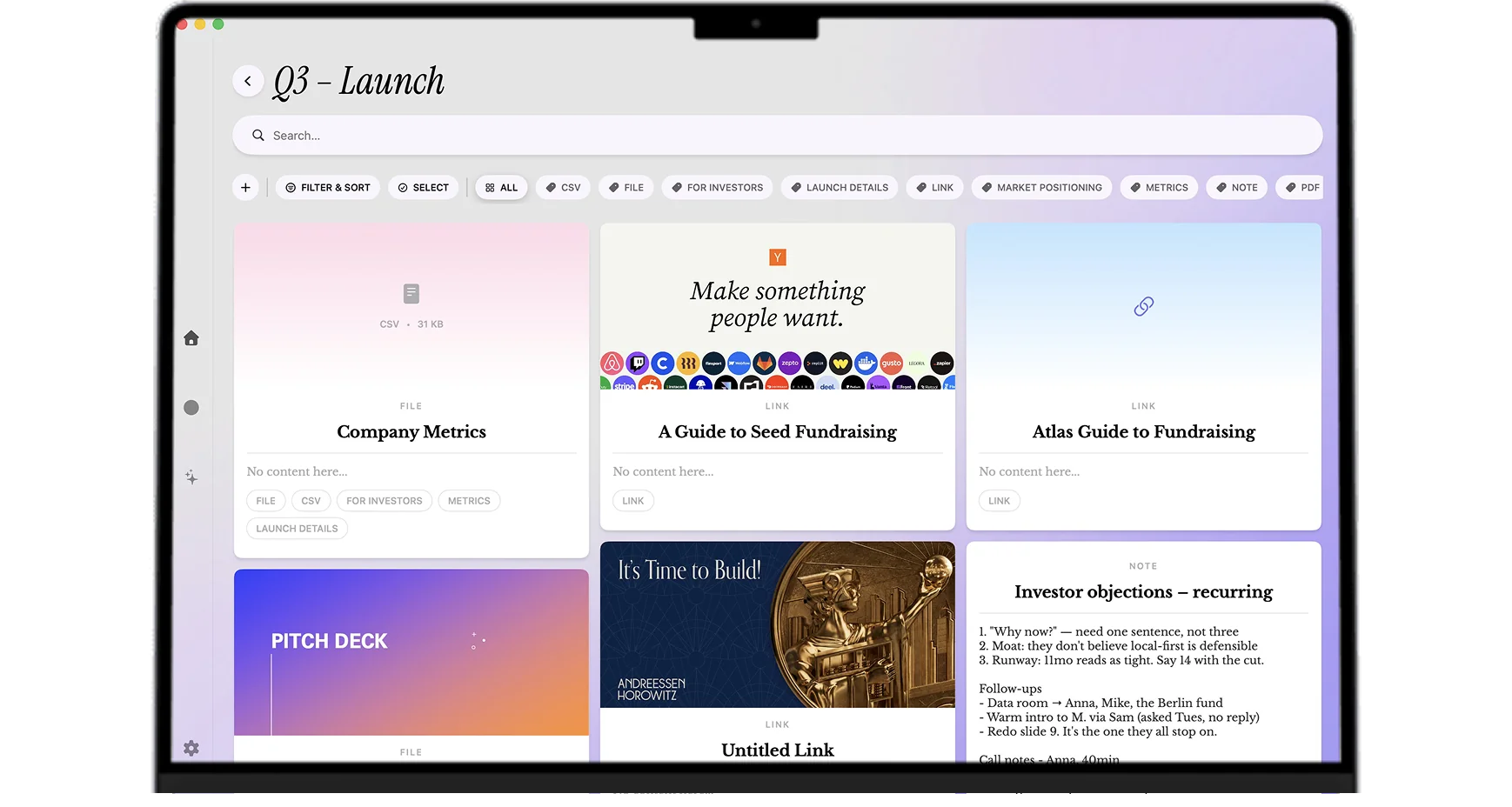
What you get
Customer calls, specs, competitor notes, and stray ideas stay captured, connected, and findable between meetings.
One shortcut saves the note, link, or file before the next call starts.
Query months of call notes and research in plain language instead of scrolling docs.
Search across everything you saved to recover why a call was made and what informed it.
Saves are tagged and summarized on arrival, so the system survives the busy weeks.
PM setups
Capture interview quotes, support tickets, sales call snippets, Slack threads, and review screenshots into one feed. AI tags by feature area, by customer segment, and by theme automatically. The "what are users actually saying about X" question gets a real answer in one query rather than a half-day of cross-referencing.
Save competitor launches, marketing pages, pricing changes, and Twitter announcements. The mind map shows where competing moves overlap with your roadmap. Quarterly competitive review goes from a panic-week assembly job to a thirty-minute walk through the library.
One note per initiative in flight. Problem statement, customer evidence linking back to the source feed, scope, open questions, decisions made, decisions deferred. Pull the customer quotes directly from the signal feed so the brief stays grounded in real evidence rather than your best memory of it.
Record voice memos right after meetings while context is fresh. Transcripts and AI summaries make the post-meeting writeup nearly automatic. Action items get due dates and reminder times so the commitments you made in the room actually get tracked through to completion.
Open the mind map every few weeks and look at how customer feedback themes are evolving. The theme that has been quietly growing for three months is often the right input for the next prioritization conversation, and it surfaces in the map before it shows up in any single piece of data.
Draft strategy memos, OKR rationale, and prioritization arguments inside Mindly with the customer evidence and competitor context one shortcut away. The strategy artifact and the evidence base live in the same library rather than across three apps, which makes the strategy work both faster and more defensible.
Common questions
For PMs who run their own customer discovery, want one library that holds interview quotes, competitor moves, meeting notes, and strategy thinking, and need to make prioritization decisions backed by real evidence, Mindly is the closest fit on Mac in 2026. The advantages over Notion or Productboard for personal PM use are that AI tags customer signal automatically, voice memos transcribe between meetings, and the cross-customer pattern recognition surfaces themes that team-facing roadmap tools do not.
Productboard is a team-facing tool for collecting feedback and managing prioritization across stakeholders. Notion is a workspace for shared docs and team wikis. Linear is for engineering execution tracking. All three have their place. Mindly is a different layer: the personal PM evidence library where customer signal accumulates, gets tagged, and feeds the strategy thinking that eventually shows up in team-facing tools. Most PMs who switch keep Productboard or Notion for team-facing work and use Mindly as the personal discovery library that informs it.
Yes. Gong, Otter, Fireflies, and most call-recording or transcription tools export transcripts as text, Markdown, or PDF. Drag the export into Mindly and every transcript becomes a searchable, tagged item. AI runs a tagging pass over the transcript content, which is often more useful than the per-call tags those tools generate by themselves. For PMs doing five to ten customer calls a week, this turns the call recording archive from a write-only system into an active library that contributes to decisions.
Your library lives on your Mac in a Mindly directory. AI processing happens over encrypted channels and content is not retained on Mindly servers after the request. For most PM confidentiality requirements (NDA-bound interview transcripts, unreleased roadmaps, sensitive competitive analysis, internal strategy memos) the on-device library plus no-retention AI is the right combination. For specific regulatory requirements (HIPAA-covered data, certain enterprise customer agreements), check the privacy policy and your company's data handling rules before processing identifiable content through cloud AI.
Mindly's integration set today covers Notion, Google Drive, Dropbox, and Readwise. Linear and Jira integrations are not built in. Most PMs use Mindly as the personal evidence layer that feeds into team tools rather than as a direct two-way sync with the engineering tracker. The pattern that works well is: customer signal and discovery work in Mindly, then write the spec or feature brief that ends up in Notion or Linear with the evidence linked from Mindly.
Install Mindly free for Mac. Capture the next five customer conversations and a competitor scan. The patterns that should drive the next quarter's priorities will surface within the first two weeks of consistent capture.