Commonplace BookCommonplace Book: Keep the Best of What You Read.
A commonplace book is a personal collection of passages worth keeping, copied out under headings so you can find them again and use them in your own writing and thinking. Renaissance students were taught to keep one, John Locke designed a two-page index for it, and the habit works as well on index cards or in an app as it did in a bound notebook.
Created by Renaissance humanists, who made it part of humanist education in the 1500s; John Locke published his index for it in 1686.
A commonplace book is a notebook of things worth keeping from what you read and hear: quotations, facts, arguments, examples, a sentence from a novel that said something better than you could. Each entry is copied out under a heading that names what it is about. The heading is what makes it a commonplace book rather than a diary or a scrapbook. Entries are filed by subject, not by date, so everything you have gathered on friendship, or risk, or the craft of writing ends up in one place. The purpose is use: a store of material for your own writing, speaking and thinking, not a record of having read.
The name comes from classical rhetoric, where Cicero called arguments that carry over to many cases "common places", loci communes. Renaissance teachers turned the idea into a notebook: in De copia (1513), Erasmus encouraged students to copy noteworthy excerpts under headings, building a stock of material for their own writing and speech, as a Cambridge University Press edition of an early printed commonplace book sets out. The headings were broad topics such as reputation or friendship, as the notebooks in Yale University Library's exhibition on early modern reading show.
The working method has barely changed since the 1500s. You read with a pencil, mark what stops you, and later copy the best of it, with its source, under a heading. The period's advice is practical. The 1706 English edition of Locke's A New Method of Making Common-Place-Books opens with advice from Le Clerc, who first printed the method in French: copy only what is excellent in matter or expression, note where in the author it came from, and do not break off reading to copy. Mark the places on a slip of paper and extract them once the book is finished, ideally after a second reading. Ryan Holiday describes nearly the same rhythm with index cards in his essay on keeping a commonplace book: he finishes a book, waits about a week, then transfers what he marked.
Keepers get two kinds of payoff. The first is retrieval: when you sit down to write about a subject, the heading already holds the quotations, examples and facts you collected over years, each with its source. The second is memory. Erne and Singh note that copying a passage out and choosing a heading for it also fixed it in the mind. Copying is slower than highlighting, and the slowness forces a decision about whether the passage deserves a place. Over time a third effect appears: headings fill unevenly, and the full ones show what you keep returning to. Holiday says the same of his categories, which emerge from the material rather than being planned.
It helps to be clear about what a commonplace book is not. It is not a journal, which is organized by date and is mostly your own experience; a commonplace book is organized by subject and is mostly other people's words, with your notes beside them. It is not a Zettelkasten, where each note is your own idea, linked to other notes. And it does not need software. A notebook, a pen and a list of headings at the front make a complete commonplace book, which is how Locke kept his for more than twenty years before he published his method.
From the source
Watch It Explained
Ryan Holiday walks through his notecard system, adapted from Robert Greene's; his 2014 essay on keeping a commonplace book describes the same cards. From his own YouTube channel, 2026.
Who it is for
Who keeps a commonplace book
Writers who need the right line at the right moment
A writer's problem is rarely having nothing to say. It is remembering, at the moment of writing, the passage read two years ago that makes the point better. A commonplace book turns that into a lookup: open the heading, and the candidates are there with author and page. Holiday keeps a separate card box for each book he writes. For how writers keep research and quotes in one place, see Mindly for writers.
Students reading for essays and exams
This is the use the practice was built for. Renaissance students kept commonplace books to stock their own writing and speech with material from their reading. A modern student can do the same: one heading per recurring theme of a course, entries copied with page numbers, and a short note on why each passage matters. When the essay question arrives, the reading has already been sorted by theme, and the copying will have done some of the remembering.
Readers who forget most of what they read
Finish a good book, and a month later you can name its title and one idea. A commonplace book is a cheap defense against that loss. You do not try to keep everything; you keep the five or ten passages that mattered, with a line of your own beside each, and you file them where you will see them again. Rereading a heading a year later brings back not only the passage but the book around it. Our guide on how to remember what you read covers the reading side in more depth.
People thinking about one subject for years
Some keepers use a commonplace book as a long conversation with a single subject: leadership, parenting, grief, a craft, a faith. Over years, the headings under that subject fill with material from sources that never cite each other: a novel, a court ruling, a talk, a conversation with a friend. Seeing them on one page is often where an original thought starts, because nobody else has read that exact mix.
The core principles
Why a notebook of other people's words works
The heading: file by subject, not by date
A dated notebook answers the question "when did I read this", which you almost never ask. A heading answers "what do I have on this subject", which you ask every time you write. Locke's rule for choosing one still holds: a heading should begin with a considerable word essential to the matter, a noun you would actually look under. "Patience" works. "Interesting things from March" does not. The heading is also where your judgment shows, because deciding what a passage is about is the first act of thinking about it.
The extract: choose, do not hoard
Le Clerc's first rule was selection: copy only what is excellent, either for what it says or for how it says it, and leave out anything within the reach of an ordinary mind. His example was a moral line from Virgil that he thought too plain to be worth copying, however true. The rule keeps the book small enough to reread. A highlight costs nothing and so means little; a copied passage cost you a minute, and that minute is a filter. If a book yields three entries, the commonplace book is working. If it yields forty, you are transcribing.
The source: always say where it came from
An unattributed quotation is a liability: you cannot cite it, check it, or find its context again. Locke was strict about this. Before copying anything from a book, he wrote down the author, the title, the volume, the place and date of the edition, and the book's total number of pages, so that a page reference would still work in another edition. Today a URL, or an author, title and page, does the same job. The habit is what matters: no entry without its source.
The return: a commonplace book is for using
Collections that are never opened again are archives, not commonplace books. The practice was built for reuse: material gathered to be redeployed in your own writing or speech, what the Cambridge scholar Jason Scott-Warren called "a process of textual recycling" in an interview for the Folger Shakespeare Library. In practice that means a scheduled return: rereading a heading before you write on its subject, or simply opening one heading a week. The return is also where the book starts producing ideas, because passages filed months apart meet on the same page.
Common mistakes
Where commonplace books go wrong (and the fix)
Copying everything
The most common failure is transcription: every highlight from every book, copied in full, until the commonplace book is as long as the reading and nobody, including you, will reread it. The fix is Le Clerc's rule, printed in 1706: copy only what is excellent in matter or expression. A ceiling helps. Pick the five best passages from a book, and if you want a sixth, drop one. For an article you want whole, save it elsewhere and put only the key passage and a pointer in the book.
Designing the headings before the material
People new to the practice often spend an evening drawing up forty categories, then find that half stay empty and the passages they actually collect fit none of them. Holiday's advice is the opposite: do not worry about categories at the start, and let the material decide them. Keepers in the 1600s had the same trouble, as the blank and crossed-out headings in Robert Southwell's notebook show. The fix: start with five broad headings and a Miscellaneous, and split or rename only when a heading gets crowded.
Losing the source
A passage without its source is half an entry. Weeks later you cannot remember whether it came from a book, a talk or a friend, and you can neither quote it nor reread the context. Screenshots and photos of pages are the usual culprits. The fix is mechanical: write the source line first, the way Locke did. Author, title and page for a book; title and URL for anything online; speaker and date for something heard.
Keeping a book you never open
Many commonplace books are write-only. Entries go in, nothing comes out, and after a year the keeper concludes the method does not work. The problem is not the collecting but the missing return. The fix is a small, fixed appointment: once a week, open one heading and reread it, and before you start any piece of writing, check the matching headings first.
The full guide
Keeping a Commonplace Book, Step by Step
Where the commonplace book comes from
The idea is classical, the notebook is a Renaissance habit, and the practice has survived every change in technology since.
The word comes from rhetoric. Building on Aristotle, Cicero described a topic as the place, or locus, of an argument, and called the arguments that could be transferred to many cases common places, loci communes. Medieval florilegia collected extracts, but usually without headings. The headings came with the humanists. In De copia verborum (1513), Erasmus encouraged students to improve their eloquence with suitably structured notebooks: noteworthy excerpts copied into sections under headings, ready to be retrieved for writing or speech. Both points come from the introduction to a Cambridge edition of a printed commonplace book from 1600.
Renaissance writers borrowed a metaphor from Seneca's letters. The reader is a bee that gathers nectar from the flowers of literature, stores it in a honeycomb with separate compartments, and turns it into honey. The commonplace book was the honeycomb, its headings the compartments, and the honey the reader's own writing. Printers even sold the empty structure: John Foxe's Pandectae locorum communium (1572) came with an index and Latin headings at the top of its pages but was otherwise blank, ready for its owner to fill.
Real notebooks were messier than the advice. The commonplace books in Yale University Library's exhibition Not Reading in Early Modern England rarely follow the established templates. Robert Southwell's book from around 1653 has headings left blank, others that needed more than one page, and headings crossed out and replaced. William Hill's notebook from around 1634 puts a line on death beside recipes for ink. Readers did not only copy the classics, either: Erne and Singh describe Edward Pudsey's notebook, arranged under commonplace headings, which includes passages from contemporary plays, Othello among them.
Critics already worried that collecting could stand in for thinking. The same Yale exhibition quotes Richard West, writing in 1638, about readers whose "Braines lye all in Notes". The practice also outlasted the Renaissance: Harvard Library's digital collection on the history of reading includes commonplace books used by Joseph Conrad, Washington Irving and Victor Hugo.
How Locke's index works
John Locke did not invent the commonplace book. What he designed was a way to find things in one. He set it out in a letter to his friend Toinard, written in Latin in 1685, printed in French in 1686 and published in English in 1706, after his death, as A New Method of Making Common-Place-Books. By then, he wrote, he had used it for more than twenty years.
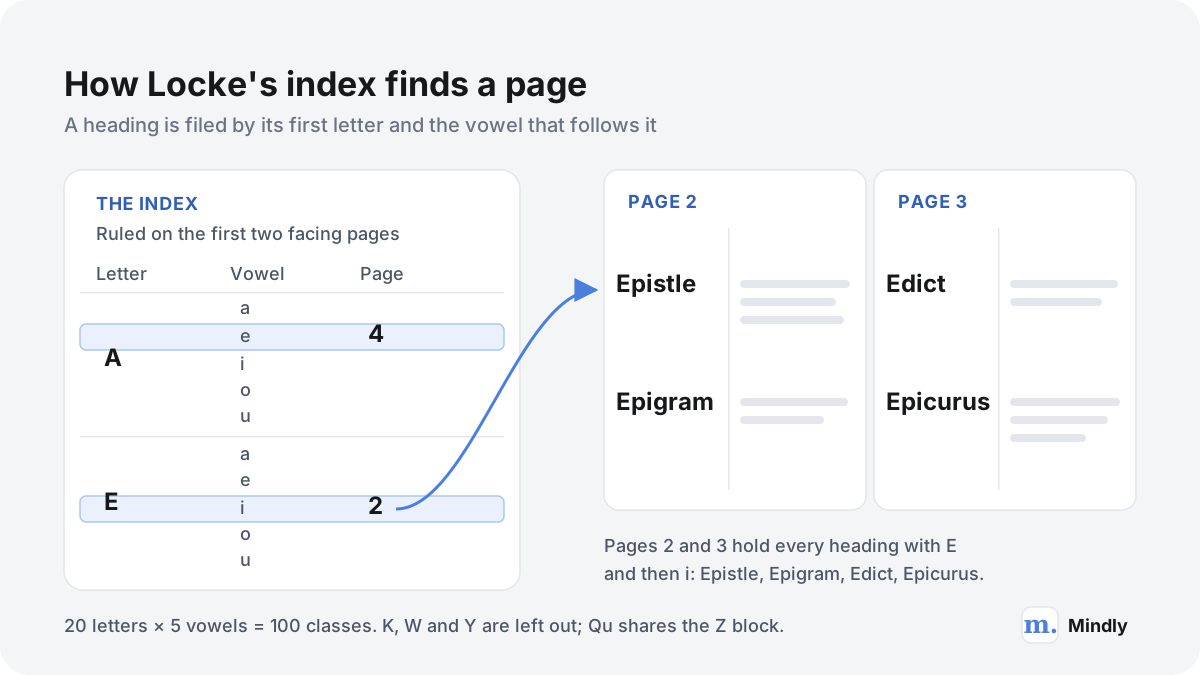
The index means you never divide a notebook among subjects in advance. Pages go to a subject only when its first entry arrives, and a two-page table at the front records where each one went. Here is the method as Locke describes it.
Rule the index. Take a blank notebook. Rule the first two facing pages into 25 equal rows, divide them into columns with vertical lines, and ink every fifth line so each column breaks into blocks of five rows.
Label the blocks. Give each block a letter, and each row in the block one of the vowels a, e, i, o, u, in order. Locke used twenty letters. He dropped K, Y and W as covered by C, I and U, and put Q, which is always followed by u, in the last row of the Z block. Twenty letters times five vowels gives a hundred classes.
Rule a margin. On the other pages, rule a margin about an inch wide. Only headings go in the margin, so they stand out when you leaf through.
Choose a heading. Pick a heading that begins with a considerable word essential to the matter. Note its first letter and the first vowel after it. For EPISTLE, that is E and i.
Look it up. If the E i row has a page number, turn there and write the entry. If it is empty, find the next blank left-hand page, write its number in the E i row, and write the heading in large letters in that page's margin. In a new book, that is page 2.
Keep the pair of pages for that class. Pages 2 and 3 now belong to every heading with E and i, such as Locke's examples Epicurus, Epigram and Edict. Starting on the back of a leaf means the two pages face each other, so all the class's headings are visible at once.
Continue when full. Carry on at the next blank left-hand page. If it follows directly, write V, for verte, turn over. If not, write the new page number at the bottom of the full page and the old one at the top of the new page, and add the new number to the index.
Cite by page over total. Record each source once, with its edition details and total page count. Each entry then carries its page over that total, 259 over 626 in Locke's example, so the passage can be found in another edition by proportion.
Locke's index in miniature: a heading is filed by its first letter and the vowel after it. Drawn from the description in the 1706 edition.
Two details show how much use the scheme had seen. Locke noted that in twenty-five years he had never needed a heading beginning with Z and u, which is why Q could share that row. And he tried a five-hundred-class version with a second vowel, then went back to the hundred, preferring a separate book for each field of study.
Locke's index today
Few people will rule a vowel grid now, but the principles survive any medium: a single key word as the heading, one index you consult first, space assigned only when a subject needs it, and all of a subject's material visible at once. Three adaptations:
A paper notebook. Number the pages and keep the first two or three as an alphabetical index of headings and page numbers. When a heading's spread fills, write "continued on p. 47" at the bottom and "from p. 12" at the top of the new page, which is Locke's cross-reference in plain words.
Index cards. The box is the index. Write the heading in the top corner of every card, as Holiday does on his 4×6 cards, and file them behind dividers. A heading can grow by any number of cards, so overflow is never a problem.
Software. The heading becomes a tag or the first word of the entry, and search replaces the grid. Still keep one Index note listing your headings, because a list you can read in a minute is the fastest way to see what the book holds and to stop near-duplicate headings.
A worked example
Here is one reading session turned into three entries. The passages come from the sources this page cites, so you can check each one.
The reader works through Locke's 1706 pamphlet and Yale's exhibition, marking places rather than copying. A few days later they copy the best three. Each entry has four parts: a heading, the passage, the source, and a short note in their own words.
Entry 1
MEMORY
Passage: memory is "the Treasury or Store-house", judgment puts in order what is drawn from it, and order and method keep memory from being overloaded. Source: Le Clerc, in Locke, A New Method of Making Common-Place-Books, London, 1706, p. i. My note: the case for a commonplace book in one paragraph. Memory stores but does not sort. The book does the sorting once, on paper.
Index: M e · See also: Notes, criticism of
Entry 2
NOTES, CRITICISM OF
Passage: "Braines lye all in Notes", said of learned readers who copied their knowledge from quotations. Source: Richard West, 1638, quoted in Not Reading in Early Modern England, Yale University Library online exhibition. My note: the oldest complaint about note systems is nearly four hundred years old, and it is fair when the notes are never reread. The answer is not fewer notes but a return: a heading that gets reopened whenever I write on its subject.
Index: N o · See also: Memory
Entry 3
HEADINGS
Passage (paraphrased): do not worry about categories at the start; the material you find will decide them. Source: Ryan Holiday, How and Why to Keep a Commonplace Book, 2014. Compare: Robert Southwell's notebook, about 1653, with headings left blank and others crossed out and replaced, in the same Yale exhibition. My note: two keepers, about 360 years apart, with the same lesson. Planned headings fail; grown ones hold. Start with a few and split them when they crowd.
Index: H e · See also: Notes, criticism of
Look at what each part does. The heading is a single noun you would actually look under, which is Locke's rule. The source line is complete enough to quote from or go back to. The passage is short, a phrase or a marked paraphrase rather than a page. And the note is where the entry becomes yours. Entry 3 shows the most useful habit of all: it connects two sources that never mention each other, which is how a collection becomes something you can think with. The "See also" line is optional but cheap. Locke's index tells you where a heading lives; cross-references tell you which headings belong together.
Setting one up on paper and in software
Holiday's view is that the "book" part matters less than having a physical resource of some kind. The same logic holds for software: choose the format you will actually open.
Format
How headings work
How you find things
Watch out for
Bound notebook
Written in the margin, Locke style, on assigned pages
An index on the first pages
A busy heading ends up spread across the book
Index cards in a box
Written in the top corner of each card
Dividers, and shuffling the cards
Hard to search, and easy to lose when you travel
Notes app or text files
A tag, a folder, or the first word of the entry
Search, plus an Index note
Folders invite deep trees; keep one level
Second-brain app with AI
Your heading in the text, plus automatic tags
Plain-language search across everything
Automatic tags are not your headings; keep your own
Four formats, and the same four parts in every entry: heading, passage, source, note.
On paper
Use a notebook with numbered pages and reserve the first two to four for the index. Write the source line before the passage, every time. Holiday copies onto cards by hand and only types up the very long passages. His rule is one piece of information per 4×6 card, heading in the top right corner, and he calls the ability to shuffle cards into new groups crucial.
In software
Make each entry its own note, the way atomic notes work: one passage, its source, your note, and the heading. A separate note can carry more than one heading and turn up in any search. Put the heading first in the title or as a tag, and keep a single Index note. If you mostly save quotes, an app built for saving quotes with their sources handles most of the clerical work.
A starter structure to copy
A complete structure you can copy into a notebook, a card box or a notes app today. It is deliberately small; add headings only when an entry has nowhere to go.
Index. One page or note listing every heading, what it covers, and where it lives.
Sources. One line per source, written once: author, title, edition or URL, date.
Six starting headings. Work, Writing, People, Mind, Life, Miscellaneous. Rename them within the first month. Holiday's own categories include Life, Death, Writing, Strategy and Misc, so broad is normal.
Marking slip. A bookmark or one running note for page numbers, so you never stop reading to copy.
Weekly slot. Thirty minutes, the same day each week, for copying, indexing and rereading one heading.
Entry template
HEADING
Passage: the words, copied exactly, or marked as a paraphrase. Source: author, title, page (or URL). My note: one to three sentences in your own words on why this matters or what it connects to.
Index: page, or letter and vowel · See also: related headings
If you want a fuller structure for everything you save, not only your reading: Second brain template →
Headings and categories: decision rules
Choosing headings is where most commonplace books stall. Four questions, asked in order, settle nearly every case.
What is the passage about, in one noun? Use that noun as the heading: Patience, Pricing, Grief, Cities. If you need a whole phrase, you probably have two entries.
Is there already a heading close enough? Use it. Near-duplicates such as Leadership and Management split your material and halve the chance you see it together. Check the index first.
Would you look under this word in a year? Name the heading for the question you will bring to it, not for the book the passage came from.
Does it fit nowhere? Put it in Miscellaneous; Holiday keeps a Misc category too. When three entries in Miscellaneous share a theme, that theme becomes a heading.
When to split, merge or retire a heading
Split when a heading takes more than five minutes to reread, or holds two distinct subjects. Writing might become Writing, craft and Writing, habits.
Merge when two headings keep receiving the same kind of entry, or you hesitate between them more than once.
Retire headings that stay empty for a year. Planned categories rarely match what a reader actually collects.
Cross-reference instead of copying an entry twice. In a notebook, write "see also Habit" under the entry; in software, give it a second tag.
None of this needs folders. A folder forces a single home before you know what an entry is for, which headings with cross-references avoid. More on that in why folders fail and what replaces them.
A weekly routine
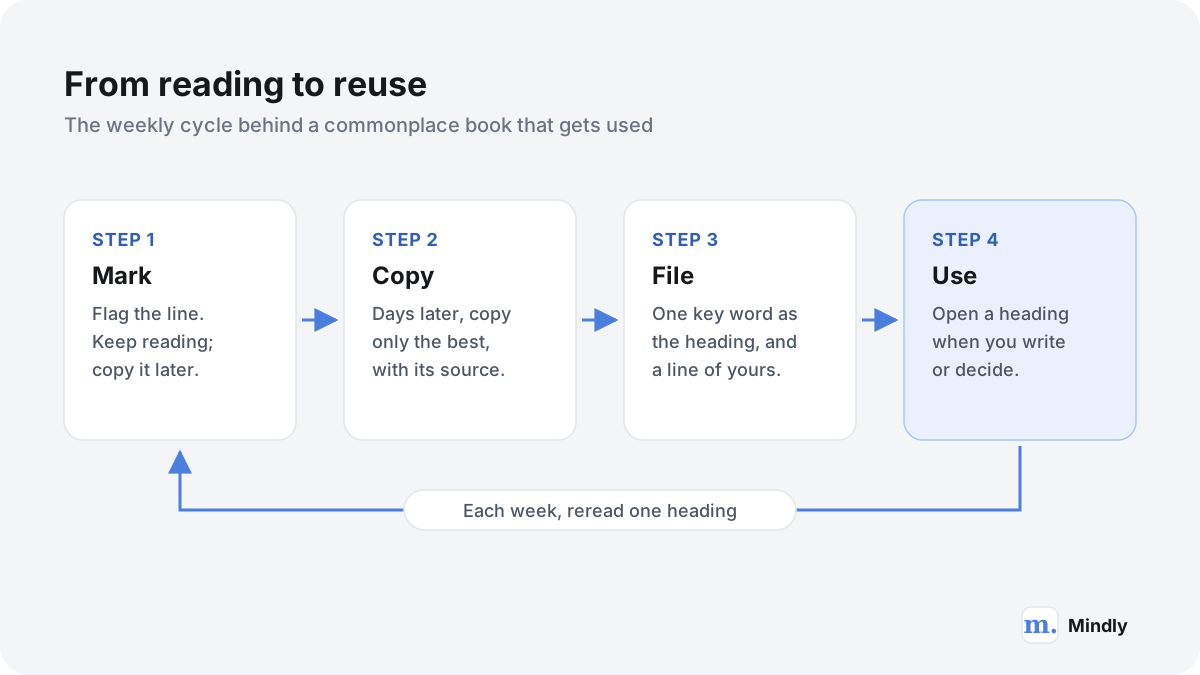
A commonplace book runs on two habits: marking while you read, and a short weekly session where marked passages become entries. Thirty minutes a week is enough.
The routine in four steps. Marking and copying are kept apart on purpose, as the 1706 edition advises and Holiday still does.
While reading
Mark, do not copy: a pencil line, a folded corner, or a page number on a bookmark. Le Clerc's reason still holds: stopping to copy breaks the thread of reading.
If a heading comes to mind, write it next to the mark. It saves time later.
For anything read on screen, capture the passage and its link in one move.
The weekly session, about thirty minutes
Gather the marks (5 minutes). Collect what you finished. Holiday waits about a week after finishing a book before transferring anything, so the weaker passages are easier to drop.
Copy the best (15 minutes). Reread the marked passages and copy only those that still earn a place: source line, passage, then one to three sentences of your own.
File and index (5 minutes). Give each entry its heading and update the index. Run any new heading past the decision rules above.
Reread one heading (5 minutes). Read one heading top to bottom and add a cross-reference where something connects. This step keeps the book from becoming an archive.
Le Clerc went further: extract from a book only after a second reading. Few people read everything twice, but judgment improves with distance, which is why the gap between marking and copying is worth keeping. A passage that thrilled you on Tuesday and leaves you cold on Sunday was not an entry.
Commonplace book, Zettelkasten and second brain
The three are often treated as the same thing. They overlap, but each answers a different question.
Aspect
Commonplace book
Zettelkasten
Second brain
Main content
Other people's words, with your notes beside them
Your own ideas, one per note, in your own words
Everything you save: notes, links, files, projects
Organized by
Headings (subjects)
Links between notes
Usually by project and area, plus search
Main question
What do I have on this subject?
How does this idea connect to my other ideas?
Where is the material for what I am doing now?
Typical output
Quotations and examples ready for writing
Arguments that grow into papers and books
Finished projects
Effort per entry
Low: copy, cite, one line of your own
High: rewrite as a standalone idea and link it
Low to capture; organizing varies
They combine well. A commonplace book is often the raw material for the other two.
The clearest difference is whose words are on the page. A commonplace book is mostly sources, gathered and filed. A Zettelkasten is mostly your own thinking: each note states one idea in your words and links to others. The two fit together: a commonplace entry is close to what Zettelkasten keepers call a literature note, and its "My note" line is often a permanent note waiting to be written.
Evergreen notes go further in the same direction: notes in your own words that you keep revising over years. When an entry's note keeps growing, promote it to an evergreen note and link back to the passage.
A second brain is the widest of the three, a system for everything you save, of which a commonplace book can be one part. Project-based methods sort by what you are working on now. A commonplace book sorts by subject, because it serves writing and thinking that has no deadline.
Can AI do this?
Partly. Software can now do the clerical half of a commonplace book very well. The other half is judgment, and that is the half that makes the book worth having.
What software does well
Capture with the source attached. Saving a passage together with its link removes the most common failure, the entry with no source.
Suggesting headings. Automatic tagging can propose what an entry is about, which helps when you have twenty passages to file.
Finding without the exact word. Locke's index only works if you remember the heading. Semantic search finds an entry from a description of it, so "that line about patience and gardening" can turn up an entry filed under Work.
Surfacing neighbours. Software can show entries close in meaning across different headings, a connection a paper book gives you only when you reread the right page.
What it cannot do for you
Choose the passage. Le Clerc's rule, copy only what is excellent, is a judgment about what matters to you. An AI that extracts "key quotes" gives you its selection, and one you did not make you are unlikely to remember.
Write your note. The line in your own words is where the entry becomes yours. A generated note can read well and still say nothing you thought.
Replace the reading. A summary of a book is not a set of passages from it. Summaries compress, and what they drop is often the specific sentence you would have copied. The trade-off is covered in what AI summaries leave out.
Make the return happen. Software can show you that a heading exists. Only you can sit down and reread it.
A fair division of labour: let software handle capture, sources, tagging and search, and keep the choosing, the note and the weekly reread for yourself. The Renaissance version worked the same way. The notebook stored and sorted; the reader judged.
Limitations, and when not to keep one
A commonplace book is one of the most durable reading practices there is, but it has real limits.
Collecting can stand in for thinking. West's complaint from 1638 is still the main risk. A thousand well-filed quotations are worth less than ten pages you wrote using twenty of them.
Headings decide what you can find. An entry under the wrong heading is effectively lost in a paper book. Cross-references help, and search helps more.
Quotations lose their context. A sentence lifted from an argument can come to mean something its author never intended. The source line lets you check before you quote it in public.
It costs time every week. Without the weekly session, a commonplace book decays into a pile. If you cannot protect the slot, a lighter habit such as progressive summarization of the articles you save may suit you better.
It is the wrong tool for project files. Contracts, drafts and meeting notes belong in a project system. A commonplace book is for material without a deadline.
When not to keep one
Skip it if you read little and write less: the payoff comes from reuse, and without writing, teaching or deciding there is little to reuse. Skip it if you mainly want to develop your own ideas into arguments, which a Zettelkasten does more directly. And do not start one in the middle of a deadline; start with the next book you read for pleasure. For other approaches, the overview of note-taking methods compares the rest.
How Mindly fits
How to keep a commonplace book in Mindly
The honest starting point is that a commonplace book needs no software. Locke kept his in a ruled notebook for more than twenty years. Software earns a place only by making the clerical parts cheaper, so your time goes into choosing passages and writing your note. Capture is one keystroke: ⌘M opens capture from anywhere on your Mac, so a passage you are reading online goes into your library together with its source URL, and a line from a printed book can be typed or simply spoken, because Mindly captures notes, links, files and voice. Write your heading as the first word of the entry and your note beneath it, as on paper. Mindly's AI then tags and summarizes each item automatically, a second set of headings you never had to maintain, and semantic search finds an entry from a plain-language description, so the passage filed under Work still turns up when you search for patience. The mind map view shows how entries connect across headings. What Mindly does not do is choose the passages or write your notes, and it should not: those are the parts that make the book yours. The free tier covers 25 items with no account needed, enough for a few weeks of entries. If you end up preferring paper, nothing is lost. The method never needed an app.
Common questions
Commonplace Books, answered
What is a commonplace book?
A personal notebook of passages worth keeping, such as quotations, facts, examples and arguments, copied out under subject headings with their sources, often with a short note of your own. It is organized by subject rather than by date, so everything you have gathered on one theme can be found together and reused in your own writing or thinking.
Why is it called a commonplace book?
The name comes from the Latin loci communes, "common places". In classical rhetoric, Cicero used the term for arguments that could be applied to many different cases. Renaissance teachers, Erasmus among them, turned the idea into a notebook where students copied excerpts under headings, so that each heading became a place to find material on one subject.
What should I put in a commonplace book?
Anything you would want to find again when writing or thinking about a subject: quotations, striking facts, examples, definitions, arguments, lines from talks or conversations. The historical advice is to be selective: Le Clerc, in the 1706 edition of Locke's method, said to copy only what is excellent in matter or expression. A handful of passages per book is a healthy rate.
How do I organize a commonplace book?
By headings. Give each entry a single key word that names its subject, such as Patience or Pricing, and keep an index of headings at the front or in one note. Start with five or six broad headings plus Miscellaneous, then split, merge or retire them as the material grows. Record the source with every entry, and cross-reference instead of copying entries twice.
How did John Locke index his commonplace book?
He ruled the first two pages into a grid of twenty letters, each with five rows for the vowels. A heading was filed by its first letter and the first vowel after it, so Epistle went under E i, and the index recorded which pages each pair had been given. The method was printed in French in 1686 and in English in 1706.
What is the difference between a commonplace book and a journal?
A journal is organized by date and records your own days and thoughts. A commonplace book is organized by subject and collects mostly other people's words, with your notes beside them. You reread a journal to remember what happened; you open a commonplace book to find material on a theme. Plenty of people keep both.
Is a commonplace book the same as a Zettelkasten?
No, though they work well together. A commonplace book files passages from sources under headings. A Zettelkasten holds your own ideas, one per note, in your own words and linked to each other. The passage stays in the commonplace book, and the idea it sparked can become a Zettelkasten note.
Can I keep a commonplace book digitally?
Yes. Make each entry its own note with the heading as its first word or tag, keep the source in the body, and keep one index note listing your headings. Search replaces Locke's grid. In Mindly, ⌘M captures a passage from anywhere on your Mac, AI tags each entry, and semantic search finds entries by meaning.
Sources
What This Page Draws On
A New Method of Making Common-Place-BooksJohn Locke; London: J. Greenwood. Wellcome Collection copy, Internet Archive · 1706Locke's own description of the index and his citation method, and Le Clerc's advice on what to copy and when.
How and Why to Keep a "Commonplace Book"Ryan Holiday · 2014A modern keeper's notecard system in his own words: cards, categories, and the week-long wait before transferring.